Precise indoor positioning system for people
An indoor positioning system for people tracking in industrial applications is highly beneficial for the following:
- Safety
- Productivity
Typical safety applications include, but are not limited to:
- Tracking of personnel on the factory floors or assembly plants; inside mines, tunnels, and generally underground; in construction sites
- Minimizing the probabilities of safety violations
- Utilizing static geofencing zones – preventing unauthorized personnel from leaving safe zones and entering the dangerous zones
- Utilizing mobile geofencing zones, for example, around moving vehicles, forklifts, or cranes

Typical productivity applications are:
- Assigning a task based on the specialist’s current location, for example, checking a measurement device by the nearest technician
- Increasing productivity by minimizing unnecessary walking and waiting time
Example of people tracking in industrial environment
Typical needs:
- Safety: to minimize the risk of accidents, use geofencing to avoid being hit by vehicles or machines. Rescue if needed. Alarm buttons
- Productivity: to know where people are in real-time and to assign tasks based on location
- Monitoring: to receive data from the person on the move – health data and special data (gauges, telemetry, etc.)
Typical requirements:
- Accuracy: less than 1m; often – less than 0.5m – our system supports ±2cm
- Capacity: 20-150 people – our system supports up to 250 people out of the box. Several thousand with a Multi-Modem Architecture
- Update rate: “real-time” – our system supports typ. 1-8Hz (location updates per second per person)
- Battery lifetime: at least one shift (8-12h) – our system supports typ. 72h for the mobile beacon. Up to 1-2 weeks with battery optimization. Regular USB charger
Tracking warehouse workers
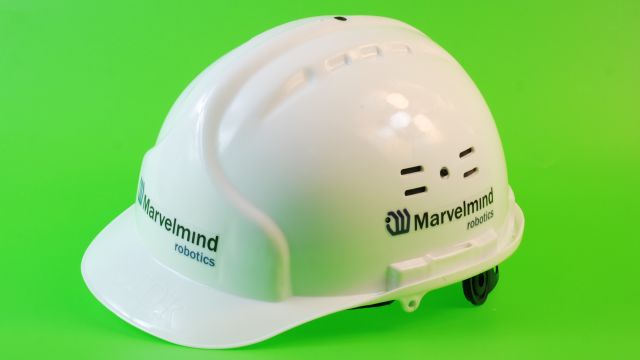
Jacket + Helmet - live tracking over 100m
Precise tracking of visitor in Cinema Museum
Recommended configurations for people tracking and navigation
1) Choose the Inverse Architecture (IA). In the inverse architecture, stationary beacons emit ultrasound, and mobile beacons receive ultrasound. As a result, stationary beacons must have different frequencies in each submap. See more in the architecture comparison.
3) Select the most suitable starter set. Or create your configuration from relevant products.
Basic configurations for easy start
Starter Set Super-MP-3D and proper mobile beacon for your needs
Overall, Starter Set Super-MP is the best and the safest choice when you are not sure what to choose or what exact experiments you will run, but you want to have the most straightforward solution with the greatest flexibility and the greatest performance at the same time
Stationary beacons + modem:
- Starter Set Super-MP-3D – the main set. It may be sufficient for the very first experiments. Then, you could expand with additional Super-Beacons
- Super-Beacon – additional mobile or stationary beacons for expansion. Switching between the mode is just a click on the Dashboard
Mobile beacons:
Jacket
Use the Marvelmind Jacket when you can use the Marvelmind Helmet, Headlight, or Cap.
The Jacket has two pairs of microphones – on the left shoulder and the right. It is done to prevent the worker’s head or neck from creating a non-line-of-sight condition with the stationary beacons nearby.
Headlight
Use Marvelmind Headlight for heavy-duty industrial applications. As compared with Helmet, it has:
- Room for external optional batteries on the back of the head – up to 5-7 times longer working time than with the embedded battery only
- Additional microphones – to provide robust coverage when the person wearing the Headlight is in a non-line-of-sight situation with the tip of the Helmet
- Headlight can be installed on certified helmets that can’t be modified, i.e., when the Marvelmind Helmet cannot be used
Advanced configurations
After you have done basic tests and familiarized yourself with the system, moving to real-case assessment and considerations is time-consuming. Several questions will be asked and answered to develop an optimal design for your specific application and requirements.
Indoors or outdoors?
The only difference between indoors and outdoors is in the level of protection against dust and moisture. Otherwise, the system can work equally well indoors and outdoors.
When we refer to outdoors, it doesn’t necessarily mean the real outdoors. It can be indoors, underground, or anywhere; here, conditions differ from those for which the indoor version is designed.
Power supply?
Power supply for stationary beacons can be an issue because the costs of running electricity to them can be high, particularly if not planned.
We always recommend a fixed power supply as the primary choice because it gives peace of mind. However, a large external battery is a viable option as well.
See more: Power supply options for beacons.