Architectures
Comparison
What drives everything: who emits the ultrasound – the mobile beacon (NIA / MF NIA) or the stationary ones (IA).
Not sure which to pick? Start with NIA, the simplest and most forgiving of mistakes; move to IA or MF NIA later if you need to. In one line: NIA: the mobile emits, the stationary beacons receive (simplest, start here, great for drones). IA: the stationary beacons emit on different frequencies and the mobile hears them all at once, like GPS (unlimited mobiles, silent worn beacon, best for people). MF NIA: non-inverse like NIA but on up to 8 frequencies (up to 8× the rate). Coverage is unlimited via submaps. New here? Begin with the Placement Manual and the step-by-step guide, or watch the comparison video.
Quick comparison
A concise summary with links to the full docs. Details and diagrams for each follow below.
| NIANon-Inverse | IAInverse | MF NIAMulti-Frequency NIA | |
|---|---|---|---|
| Who emits the ultrasoundthe root: everything else follows |
|
|
|
| Best forwhere to start |
|
|
|
| Not recommended |
|
|
|
| Update rateper mobile beacon |
|
|
|
| Accuracy |
|
|
|
| Range |
|
|
|
| Map building |
|
|
|
| IMU sensor fusion |
|
|
|
IMU sensor fusion. Today’s beacons (Super-Beacon-4, Industrial Super-Beacon-4, Industrial-RX-4) already support it in hardware; the real-time fusion software works in IA today and is coming to NIA and MF NIA (June 2026, details).
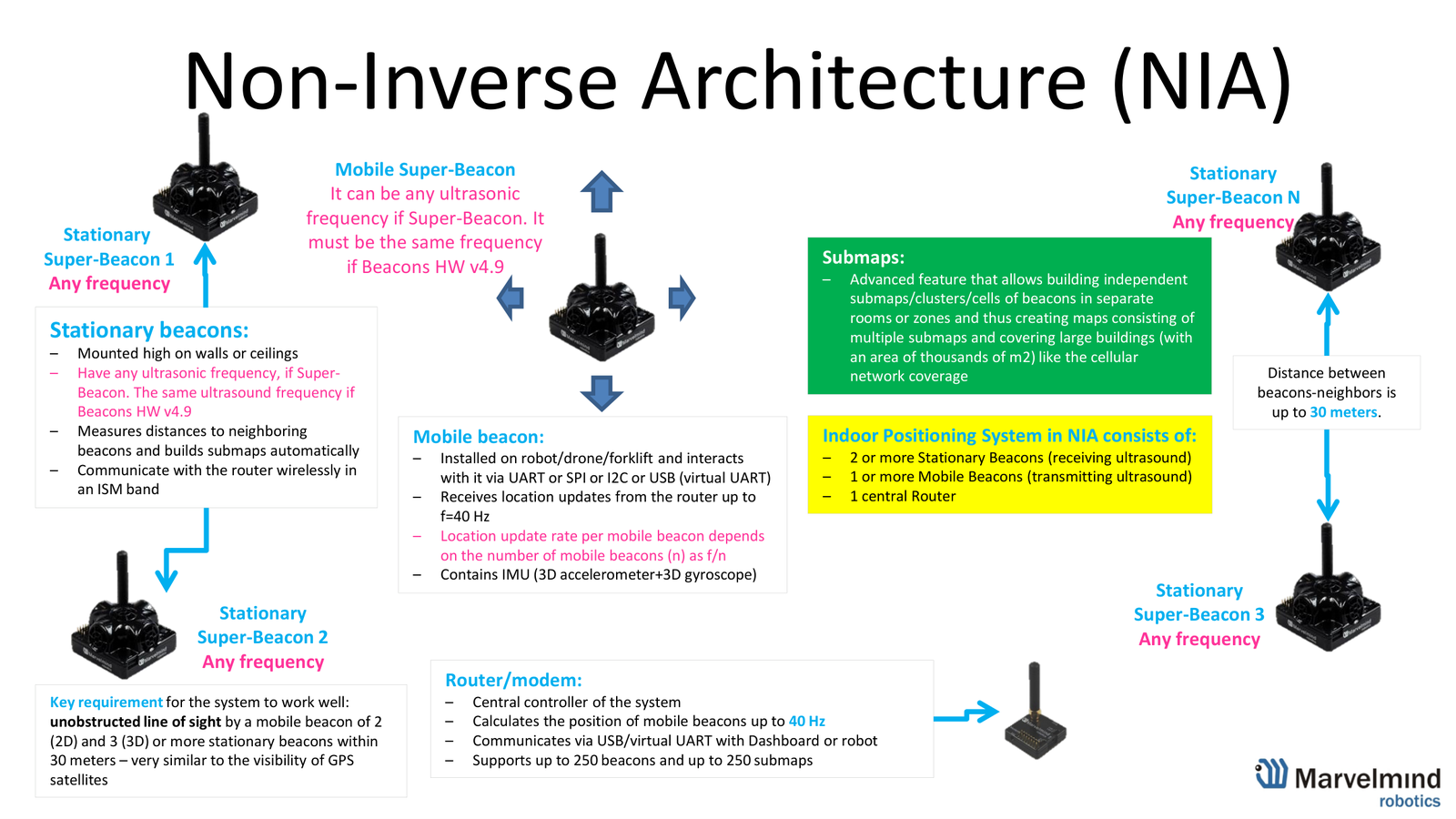
NIA, Non-Inverse Architecture (start here)
NIA is the default, and the place to start. It is the simplest architecture and the most forgiving of setup mistakes, so begin with NIA even if you plan to move to IA later, and advance in small, step-by-step stages. The one fact that drives everything: in NIA the mobile beacon emits ultrasound and the stationary beacons receive it; one Modem computes the position.
Why the update rate behaves as it does: the mobile emits on a single frequency, so when there are several mobiles they cannot emit at the same time (you could not tell them apart). They take turns in time (TDMA), which is why the per-mobile rate is shared as f/n: with 1 or 2 mobiles it stays high, with 10 to 100 constantly-moving mobiles it drops. But not always: every beacon has an IMU, so the system tracks movers often and near-static objects rarely, and NIA then scales to many mobile objects. See the update-rate table and how to increase the update rate.
Not recommended for tracking people: a worn beacon emitting ultrasound makes a faint, audible ticking that people dislike (for people, IA keeps the worn beacon silent). Recommended for drones (the mobile emits, so propeller noise does not blind it). Accuracy ±2 cm (better with sensor fusion); coverage is unlimited via submaps, the 30 m being only the per-submap line of sight. New here? Start with the Placement Manual and the step-by-step guide.
IA, Inverse Architecture
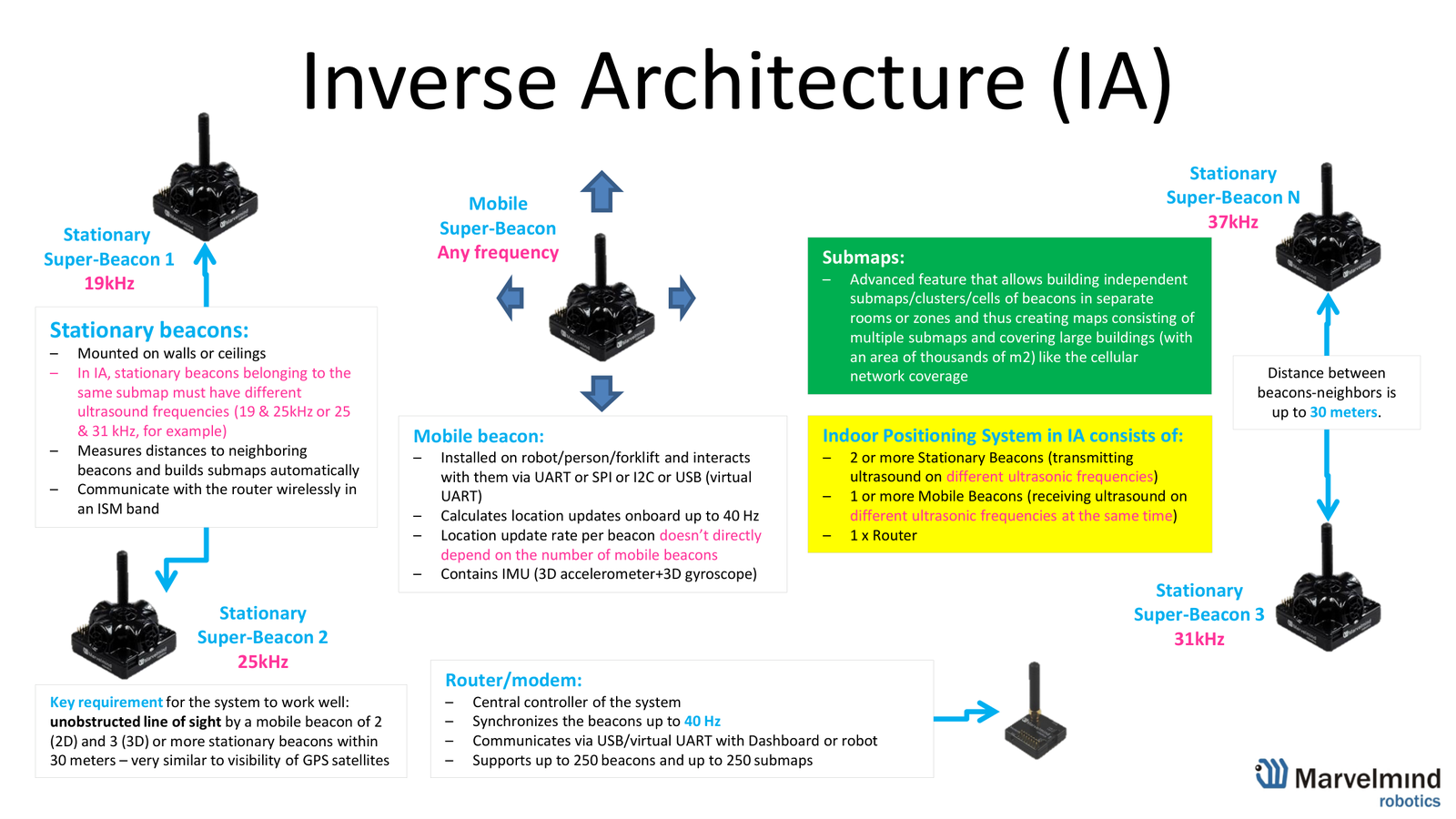
Inverse Architecture flips the roles. The stationary beacons emit, each on a different frequency (e.g. 19/25/31/37 kHz), and the mobile beacon receives them all at the same time, exactly like a GPS receiver hearing every satellite, computing its own position onboard. Because nothing is shared in time, the number of mobile beacons is practically unlimited and the per-mobile update rate barely depends on it (radio then becomes the limit, so use the 500 kbps profile; see rate table).
Best for many mobiles (people, robots, VR) and for tracking people, because the worn beacon stays silent (it only receives). Within one submap no two stationary beacons may share a frequency. Real-time IMU sensor fusion works now in IA, up to 500 Hz and ~10 ms latency (IMU sensor fusion).
Drones: a receiving mobile beacon next to the propellers makes propeller noise a challenge, but it is solvable: 15 m and even 30 m are achievable, just more advanced and for experienced users (drone-swarm solutions). For a simple drone project, use NIA. Uses Super-Beacons and the Mini-RX mobile.
MF NIA, Multi-Frequency NIA
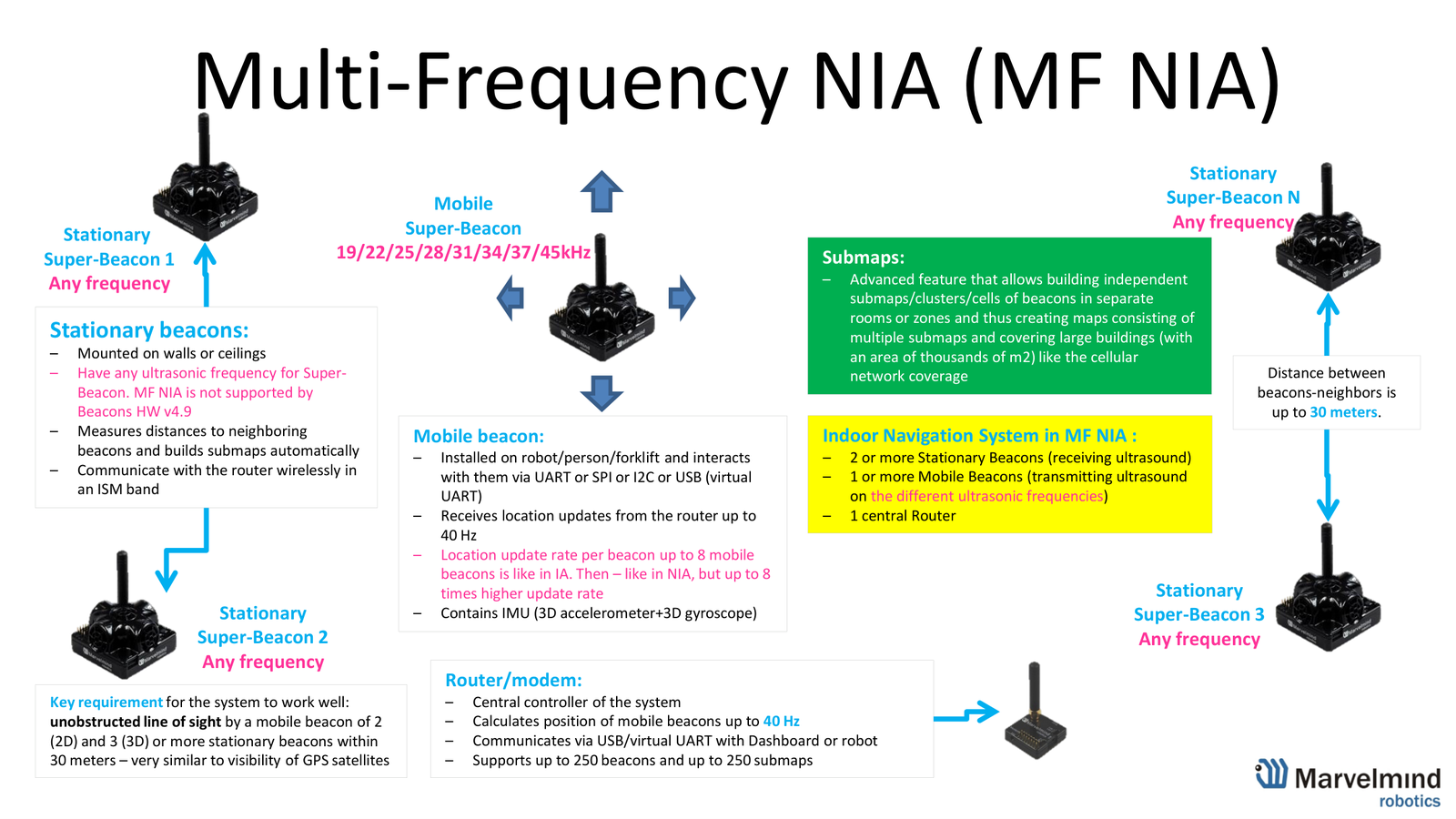
MF NIA combines the best of NIA and IA, but it is still non-inverse: the mobile beacons emit (like NIA), only now on up to 8 frequencies. So up to 8 mobiles emit at the same time (one per frequency) and the per-mobile update rate scales as int(N/8), up to 8× higher than NIA for the same number of mobiles. For 8 or fewer mobiles it behaves like IA; beyond that, like NIA but multiplied.
Best for 5 to 16 robots/drones and many mobiles that all need a high rate. Same ±2 cm accuracy, same 30 m line-of-sight rule, same unlimited area via submaps as NIA. Requires Super-Beacons (not Beacons HW v4.9). Real-time IMU sensor fusion is coming (the hardware is already there; details).
Multi-Modem, very large networks
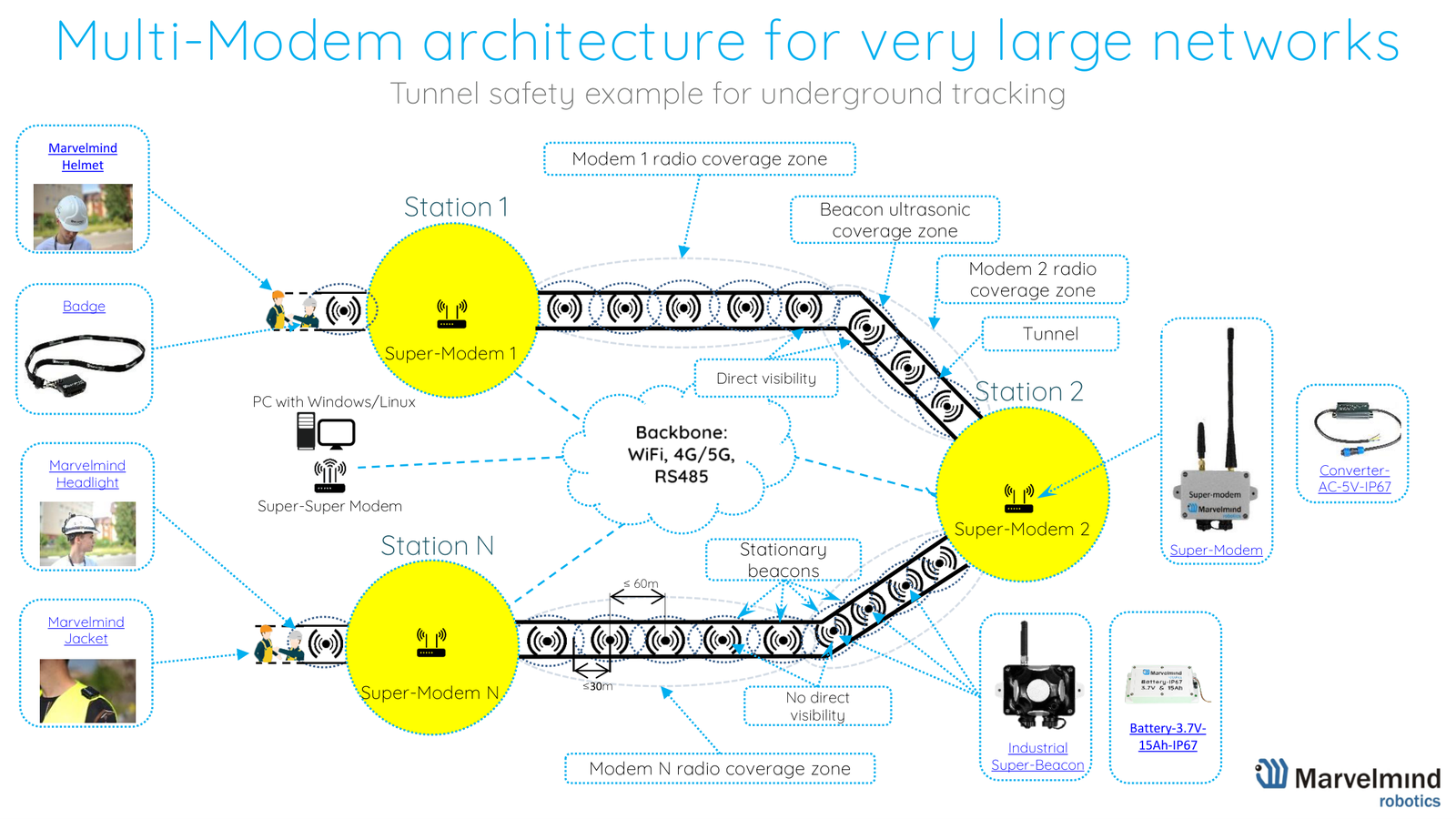
For very large linear networks (tunnels, mines, subways, long warehouses). Several Super-Modems chain together (Super-Modem to Super-Super-Modem to PC), each covering up to 60 m, so the network reaches far beyond a single modem and the total size becomes practically unlimited. Works with Industrial Super-Beacons, Badge, Helmet and Jacket wearables.
Split-Modem, fast-moving objects
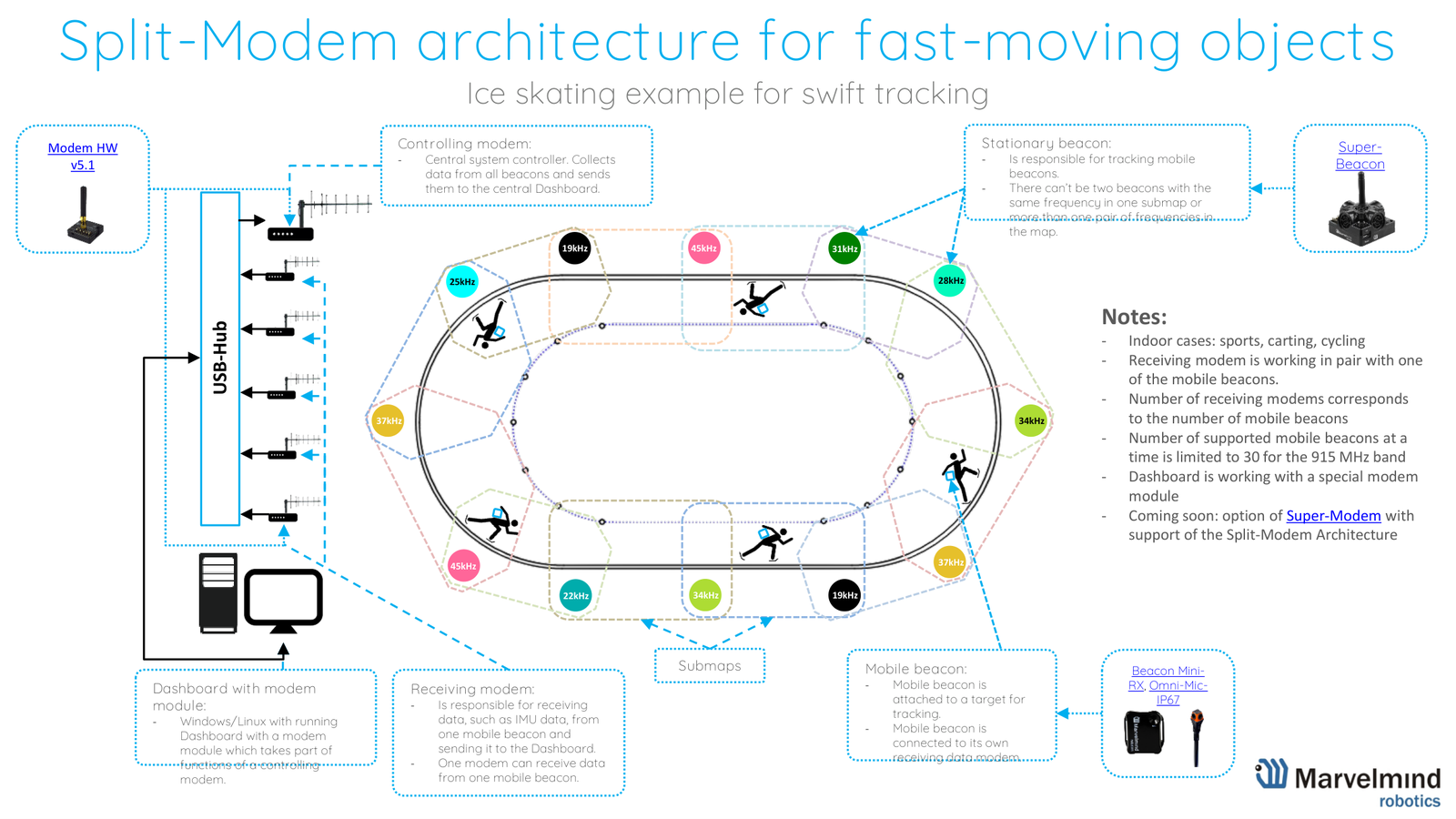
For fast-moving objects (sports, karting, cycling, ice skating). A controlling modem collects data and talks to the Dashboard; each mobile beacon gets its own receiving modem for low-latency IMU data. Up to 30 mobile beacons on the 915 MHz band. Uses Super-Beacons / Mini-RX with Omni-Microphone-IP67.
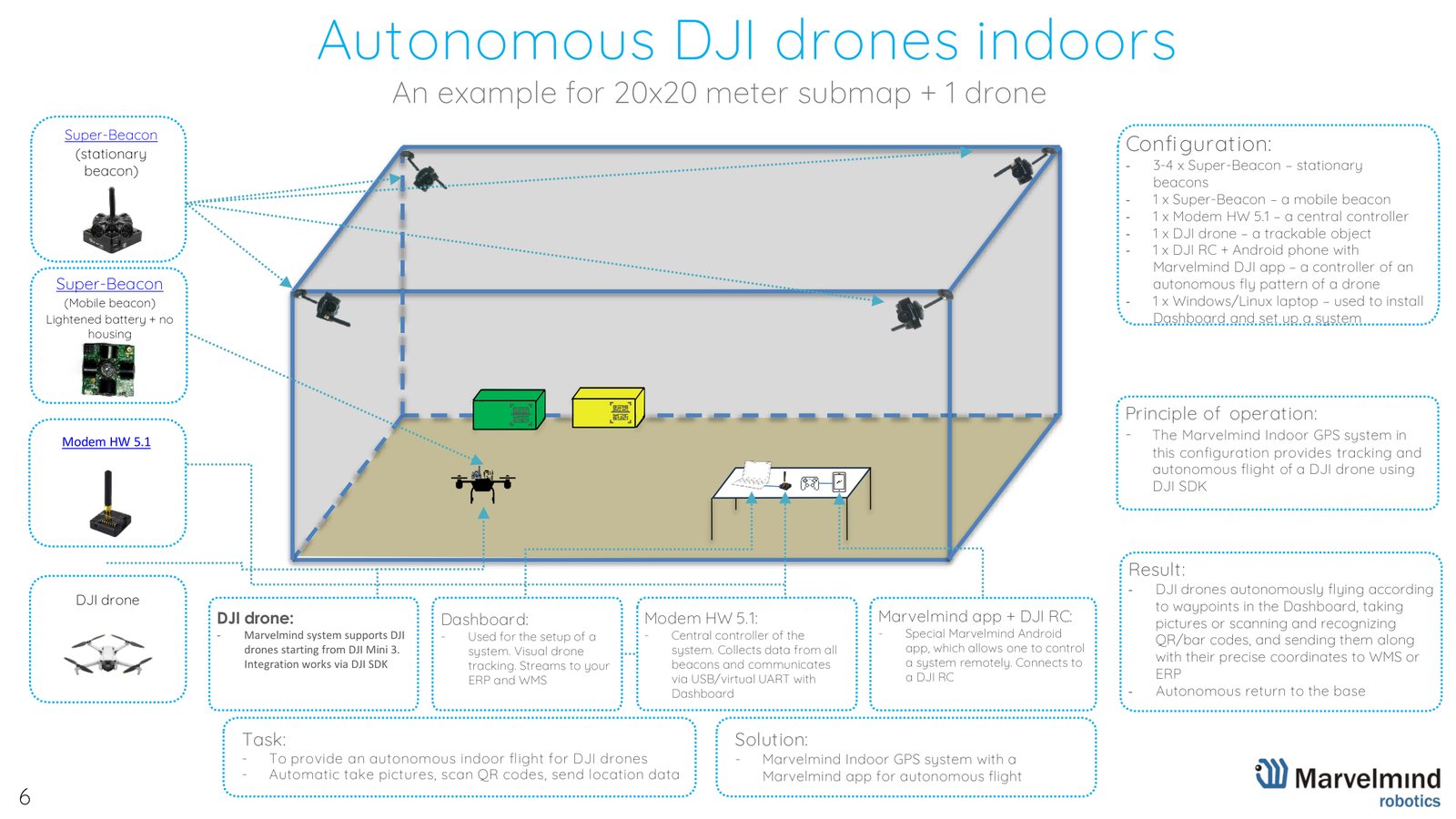
Autonomous DJI drones indoors
Drones are the flagship application. Start with the drones solution page and the DJI integration page; the details below build on them.
Autonomous indoor flight for DJI drones (from DJI Mini 3) via the DJI SDK: fly waypoints set in the Dashboard, take pictures, scan QR/bar codes and stream precise coordinates to WMS/ERP, then return to base. Example for a 20×20 m submap + 1 drone: 3 to 4 stationary Super-Beacon + 1 mobile + 1 Modem HW v5.1 + a DJI drone + DJI RC with the Marvelmind DJI app. Use NIA (or MF NIA); see the table for why. Flying many drones? Drone swarms and flying at scale.