Cart Tracking with Centimeter-Level Precision

A Complete Guide for Manufacturing and Warehouse Operations

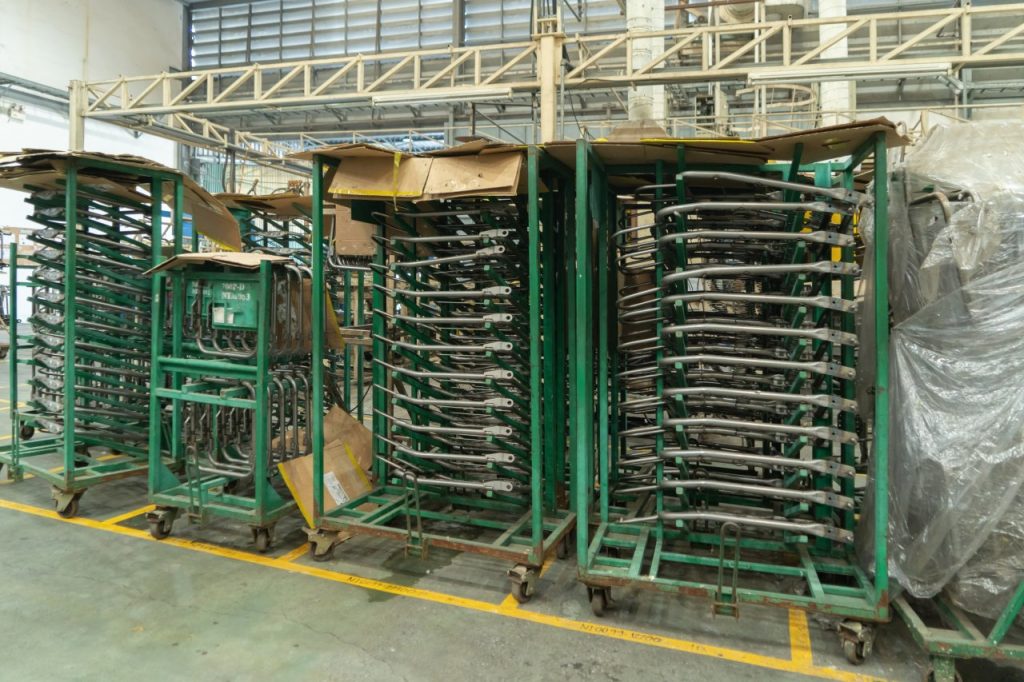
Industrial carts with ultrasound tracking beacons in manufacturing warehouse facility

Manufacturing facilities tracking hundreds or thousands of carts need precision. Not 5-meter accuracy. Not "close enough." Centimeter-level precision integrated with electronic shelf labels (ESL) and warehouse management systems (WMS) through open APIs. This is how ultrasound RTLS delivers it.

The Cart Tracking Challenge

A typical manufacturing plant: 325ft x 660ft (99m x 201m), 200,000 sq ft (18,600 sq m). Ceiling heights 12-25 feet (3.7-7.6m). Steel structures, metal racks, overhead cranes, moving forklifts. Track 500 carts with better than 30cm (12 inch) precision. Stream real-time location to ESL systems. Integrate with existing infrastructure.

The requirements stack up fast:

  • Scale: 500-1,000+ tracked objects simultaneously
  • Environment: Steel structures, RF noise, metal everywhere
  • Integration: Open APIs to ESL, WMS, ERP systems
  • Reliability: 24/7 operation, minimal maintenance
  • Cost: Investment must justify efficiency gains
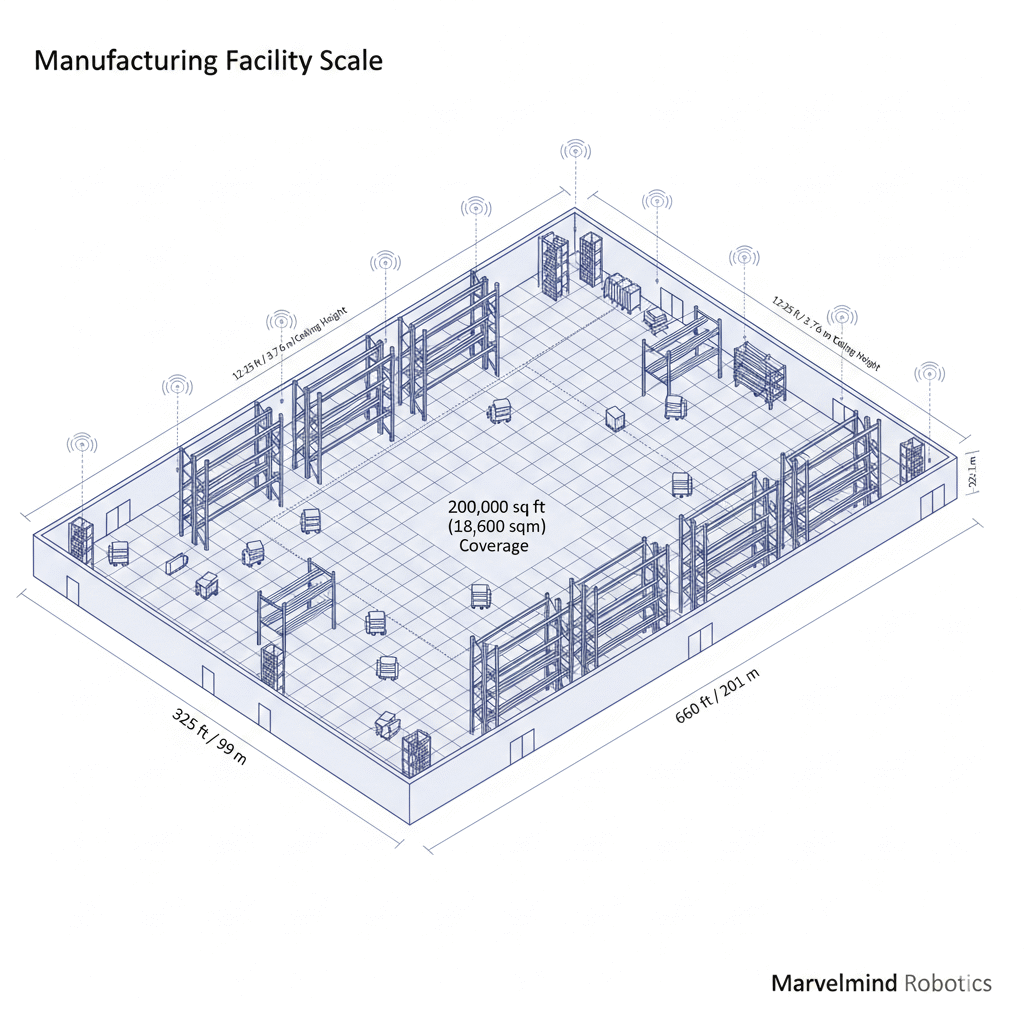
Manufacturing facility layout diagram showing 200,000 square foot cart tracking coverage with dimensions

Why Bluetooth Fails in Metal Environments

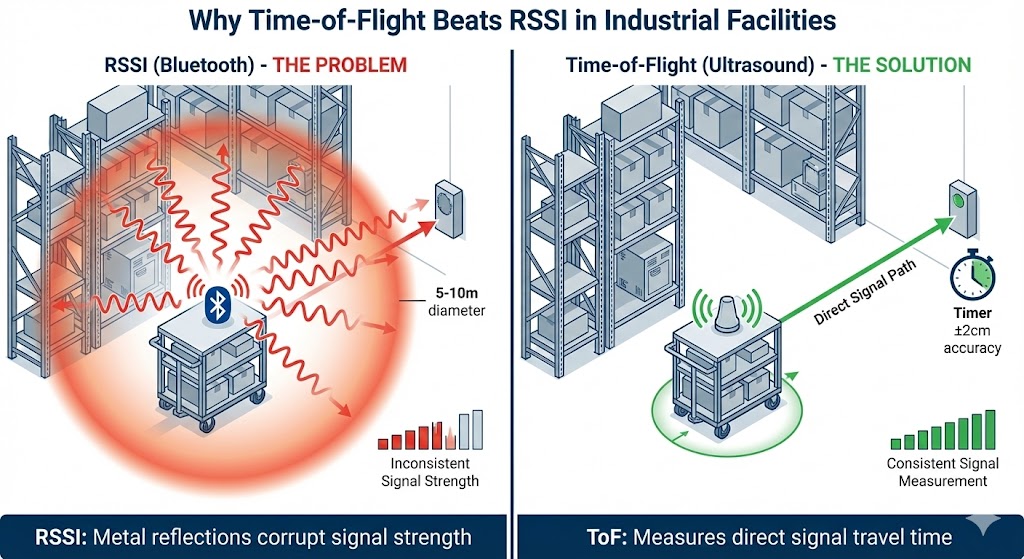
Bluetooth and BLE look attractive: low hardware cost, simple deployment. But RSSI-based positioning has a fatal flaw in industrial facilities.

The physics problem: Bluetooth measures signal strength. In facilities with steel racks, moving forklifts, and metal machinery, RSSI values fluctuate wildly. Metal reflections create multipath interference. Moving metal objects cause constant RSSI changes. Large obstructions block signals.

Real-World Result: Bluetooth/BLE accuracy degrades to 5-10 meters (16-33 feet) in metal-rich facilities. You can't determine which aisle a cart is in. This isn't implementation failure - it's physics. RSSI-based positioning doesn't work in industrial metal environments.

Time-of-Flight technologies (UWB and ultrasound) solve this. They measure direct signal travel time, not signal strength. UWB delivers decimeter-level accuracy (10-30cm / 4-12 inches) - good for many applications. Ultrasound delivers centimeter-level precision (±2cm / 0.8 inches) - optimal when accuracy requirements are critical.

RSSI signal multipath problem versus Time-of-Flight direct measurement in metal manufacturing environment

Ultrasound RTLS: Centimeter-Level Precision

Marvelmind's ultrasound-based system delivers ±2cm (0.8 inch) accuracy - more than 10x better than the 30cm requirement. This accuracy margin matters:

  • Operational headroom: System maintains performance even in challenging conditions
  • Dense storage: No ambiguity in closely-spaced rack locations
  • Integration precision: Higher accuracy enables sophisticated ESL and WMS logic
  • Future-proof: Accuracy requirements tighten as operations evolve

±2cm

Positioning accuracy in industrial facilities with steel structures and metal equipment

Line-of-Sight: Required for All Precision Systems

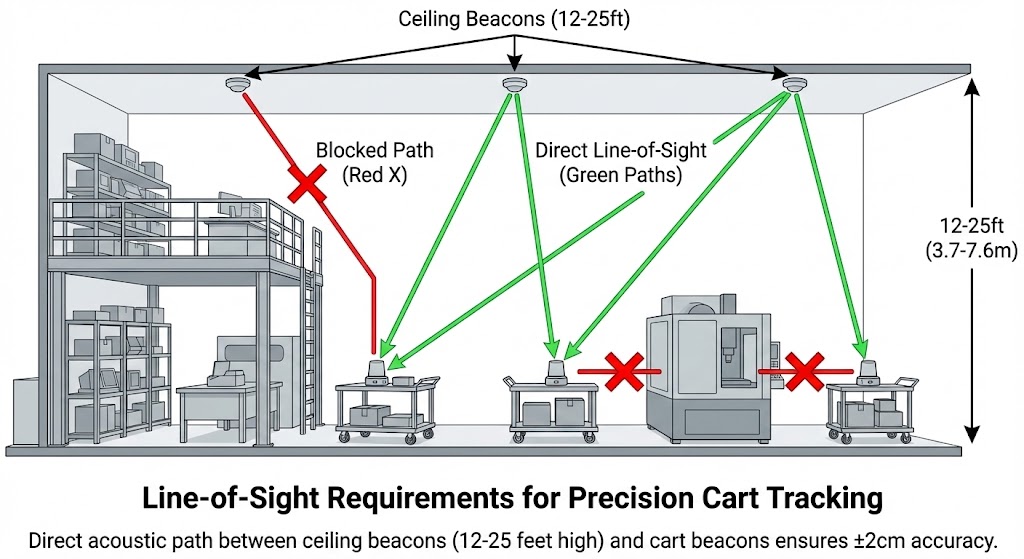
Every high-precision indoor positioning system - ultrasound, UWB, optical - requires line-of-sight. This is physics, not a limitation.

For ultrasound cart tracking: Direct acoustic path between ceiling/wall-mounted stationary beacons and cart-mounted mobile beacons. In manufacturing facilities with 12-25 foot (3.7-7.6m) ceilings and "mostly open concept" layouts, this is straightforward.

Understanding line-of-sight across technologies:

  • Visual (cameras): You can see the target
  • Radio (UWB): Radio transparency - direct RF path
  • Ultrasound: Direct acoustic path without solid obstructions

Detailed guidance: Line-of-Sight Documentation | Placement Manual (PDF)

Line-of-sight visualization showing direct acoustic paths between ceiling beacons and cart-mounted mobile beacons

Scalability: 50 to 2,000+ Carts

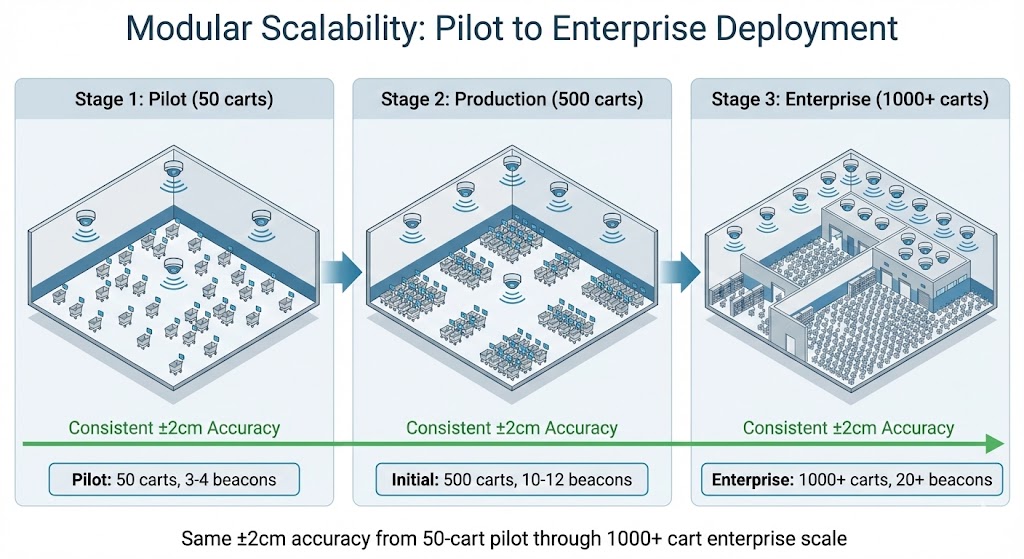
Cart tracking starts small and grows. The system must scale without architectural redesign or performance degradation.

Marvelmind's architecture scales seamlessly:

  • No hard limits: System supports hundreds to thousands of mobile beacons simultaneously
  • Modular expansion: Add mobile beacons to carts - no changes to stationary beacon infrastructure
  • Consistent performance: Same ±2cm accuracy tracking 50 carts or 2,000 carts
  • Submaps for large facilities: Coverage zones aggregate into facility-wide maps

Video demonstration - system tracking numerous mobile objects in industrial environment

Cart tracking system scalability from 50-cart pilot to 1000+ cart enterprise deployment with consistent accuracy

Open Integration: APIs and Protocols

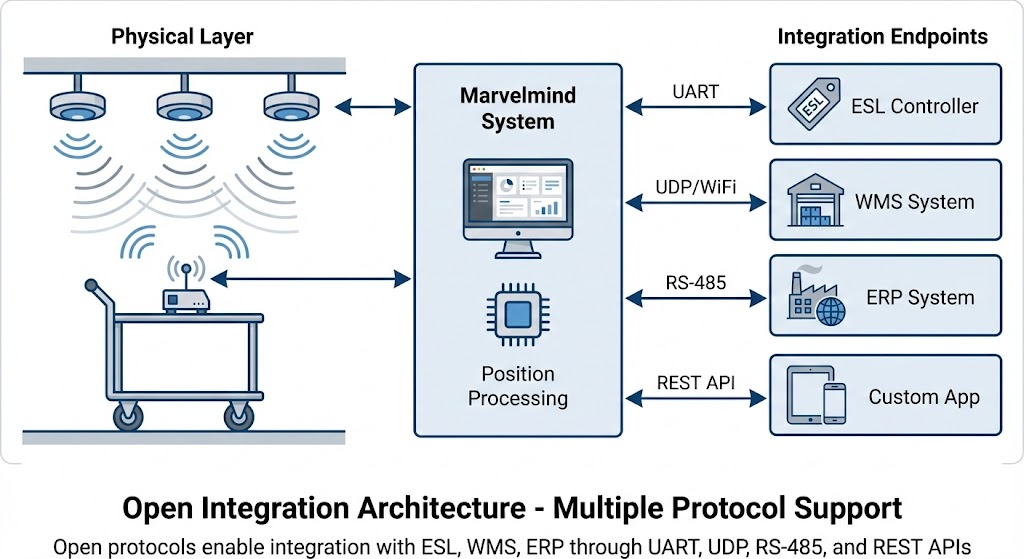
Real-time location data must feed into ESL systems, WMS, ERP platforms, and custom applications. This requires open protocols - not proprietary lock-in.

Open Protocols

  • UART: Serial communication for ESL controllers and embedded systems
  • USB: Standard PC integration and development
  • UDP over WiFi: Wireless network-based streaming for enterprise systems
  • RS-485: Industrial-grade robustness for electrically noisy environments - reliable backbone independent of WiFi
  • API Documentation: Complete integration guides

Bidirectional Communication

System streams location data out AND sends data to mobile beacons:

  • User data transfer: Several tens of kilobits per second to/from mobile beacons
  • ESL updates: Stream information to electronic shelf labels based on cart location
  • Commands: Send configuration updates and control signals to mobile beacons

This enables sophisticated workflows: cart location triggers ESL updates, WMS notifications, or automated material handling actions.

Integration Documentation

API docs, code examples, and implementation guides

Access Resources →
Marvelmind cart tracking integration architecture showing UART, UDP, RS-485 connections to ESL, WMS, ERP systems

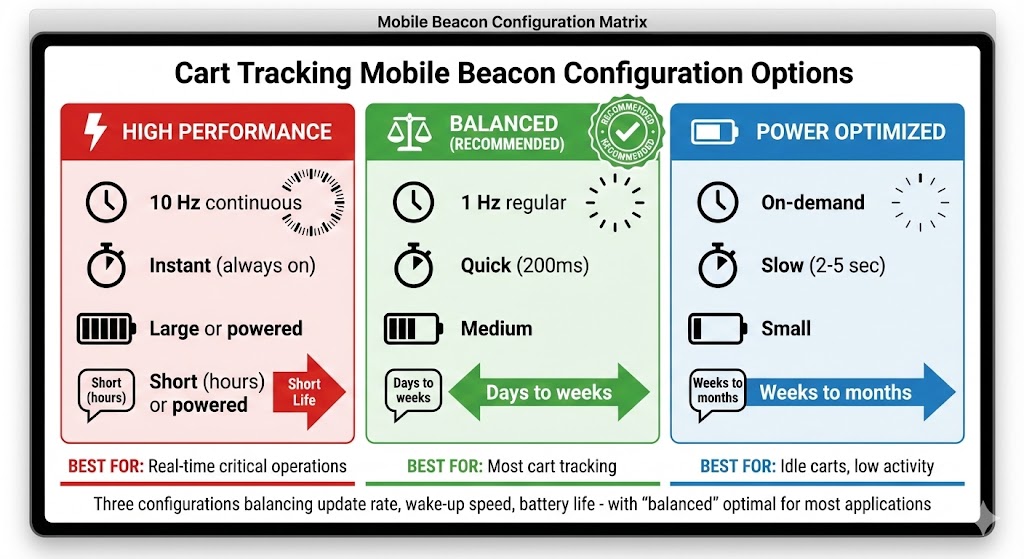
Mobile Beacon Selection: Critical Trade-Offs

Selecting mobile beacon configuration is serious engineering. Four factors compete:

  • Location Update Rate: How often system reports position (1 Hz, 10 Hz, on-demand)
  • Wake-Up Speed: Response time when location requested (instant vs several seconds)
  • Battery Life: Operating time before replacement (hours, days, weeks, months)
  • Battery Size/Weight: Physical constraints for cart mounting

The Core Trade-Off:

  • Continuous 10 Hz: Real-time tracking, instant response - short battery life or power cable required
  • 1 Hz updates: Good performance, extended battery life - optimal balance for most applications
  • On-demand: Maximum battery life - but 2-5 second wake-up delay
  • Hybrid modes: Intelligent switching between states - requires power management logic

Selection factors:

  • Cart size/mounting: Large carts accommodate extended battery capacity
  • Power availability: Powered carts eliminate battery management
  • Operational patterns: Constant motion vs idle periods
  • Environmental conditions: Indoor standard vs harsh environment enclosures

Detailed specifications: Update Rate and Data Transfer Table (PDF)

Review complete beacon options: Beacon Product Line

Mobile beacon configuration comparison showing trade-offs between update rate, battery life, and responsiveness

Planning Your Deployment

Accurate planning determines system cost and performance. Answer key questions:

  • Facility dimensions and ceiling heights
  • Line-of-sight conditions and permanent obstructions
  • Number of carts and typical locations
  • Power availability for mobile beacons
  • Required update rate and integration protocols

For 325ft x 660ft (99m x 201m) open facility: Typically requires 8-20 stationary beacons. Exact count depends on ceiling height and line-of-sight conditions.

Stationary beacon configuration:

Planning guidance: Planning Questionnaire | Placement Manual (PDF)

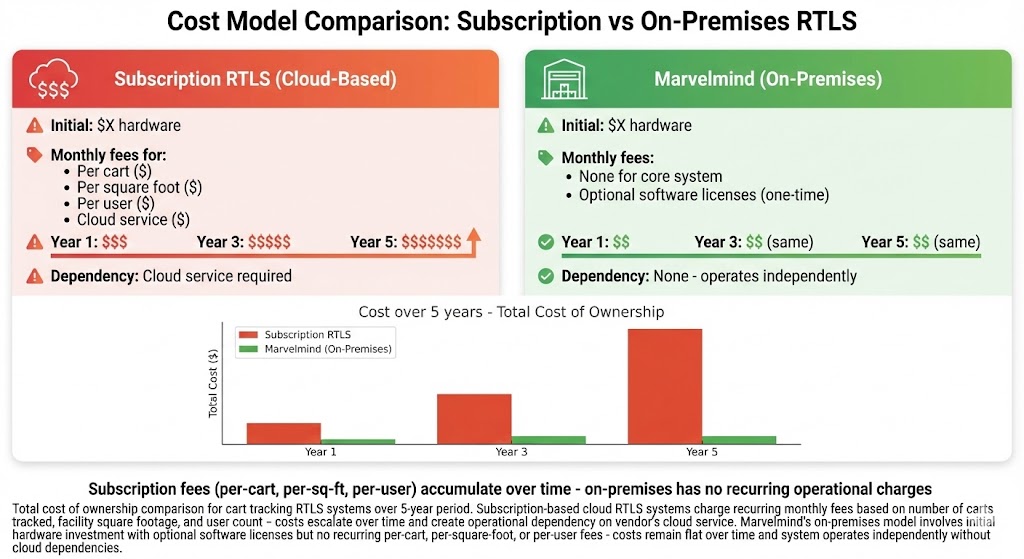
Cost Model: No Per-Cart Fees

Investment: Hardware (stationary + mobile beacons) + optional software licenses

NO recurring fees for:

  • Number of carts tracked (500 or 2,000 - same cost)
  • Facility square footage
  • Number of users accessing system
  • Per-day or per-month usage

On-Premises Deployment: Your system, your data, your control. No cloud dependencies. If vendor's cloud service fails, subscription RTLS systems stop working. Marvelmind systems operate independently.

Deployment Process

Phase 1: Planning - Complete questionnaire → Receive system design and budget estimate

Phase 2: Proof of Concept (Optional) - Small-scale validation (2-4 weeks)

Phase 3: Full Deployment - Install beacons → Deploy tags → Integrate → Validate → Train → Go live

Start Planning

Get accurate beacon counts and budget estimates for your facility

Planning Questionnaire →
Total cost of ownership comparison: subscription RTLS with recurring fees versus Marvelmind on-premises with no per-cart charges

Conclusion: Precision Without Compromise

Cart tracking with centimeter-level precision requires three capabilities: accuracy beyond requirements, scalability without limits, and open integration.

Technology reality: Bluetooth/BLE fail in metal-rich facilities (RSSI physics). UWB delivers decimeter-level accuracy (10-30cm / 4-12 inches) - good for many applications. Ultrasound delivers ±2cm (0.8 inches) - optimal when accuracy is critical.

Deployment reality: Answer planning questions → Receive system design → Optional PoC validation → Full deployment. On-premises operation means your data stays under your control. No cloud dependencies. No per-cart fees.

Scale reality: Same system architecture from 50-cart pilot to 2,000+ cart enterprise deployment. Performance remains consistent. Investment protects as operations grow.


Scroll to Top